







数据
13 7月 2026
分类
新闻
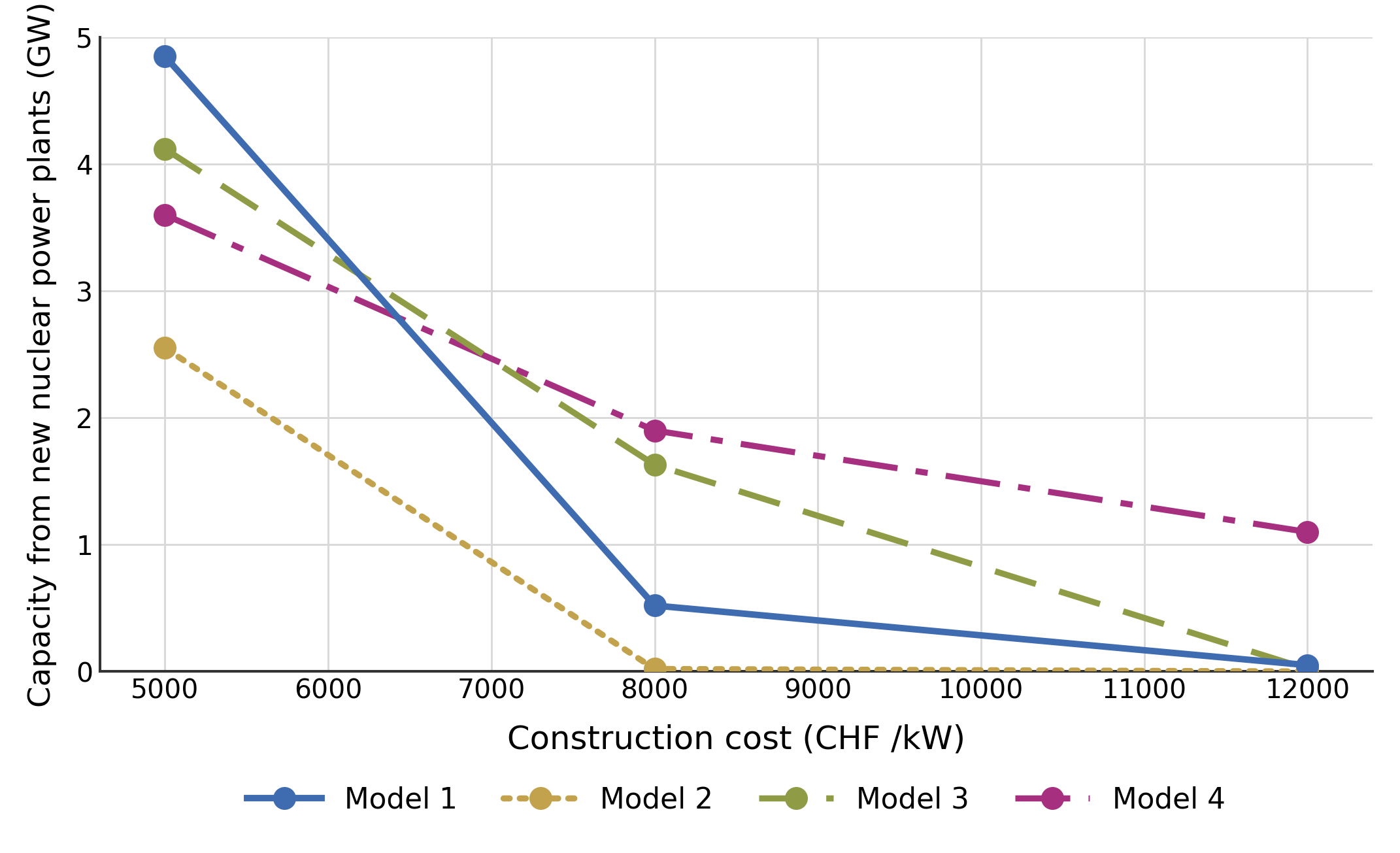
2026年6月29日,苏黎世联邦理工学院(ETH Zurich)与保罗·谢尔研究所(Paul Scherrer Institute)发布了一份联合白皮书,该白皮书由19位研究人员基于四个独立的能源系统模型共同完成。 白皮书的结论非常明确:只要满足三个条件,瑞士的新建核电项目就能具备竞争力:政府在支持可再生能源的同时也支持核电;通过担保或差价合约使融资成本从约8%降至5%;以及建设成本降至每千瓦8,000瑞士法郎或以下。 建设成本越低,其可行性就越强:即使在每千瓦12,000瑞士法郎的情况下,新核电在四个模型中仍有一个模型中具有经济可行性;而随着成本降至5,000瑞士法郎左右,具备经济可行性的模型数量将进一步增加。
这就是矛盾所在:议会一方面为新建核电站铺平了道路,另一方面却扣留了该研究报告所称的建设先决条件——即相关支持。解除禁令是正确的,但这只是决策的一半。以下五个问题阐明了已作出的决定、被忽略的内容,以及在投票前仍需解决的问题。
许可证并不等于发电厂。议会一方面批准了该项目的建设,另一方面却又将唯一能使其获得融资的条件定为非法。
1. 议会实际上做出了什么决定,又遗漏了什么?
2026年6月18日,国民院继联邦院之后,以108票赞成、87票反对的结果通过了联邦委员会针对“阻止停电”(Blackout stoppen)公民倡议提出的间接反提案,这使得十五年来首次在法律上允许建设新的核电站。 具体而言,该反提案删除了《核能法》(KEG)第12a条和第106条第1款之二——这些条款自2018年以来一直禁止颁发新建核电站的通用许可证——并新增了必须预先确保融资的要求。 从表面上看,这恢复了技术中立性。但议会多数派不仅止于单纯的许可:国民议会的立场拒绝为新建反应堆提供国家支持,并规定只有在电厂的建设和运营通过私营方式获得财务保障的情况下,才会授予框架许可。 换言之,立法者既重新敞开了大门,同时又拆除了通向这扇门的坡道。这一决定解决了合法性问题,却完全留下了实际决定核电站能否建成的核心问题:谁来承担长达数十年的财务风险——这正是苏黎世联邦理工学院(ETH)研究报告所重点强调的。
2. ETH的研究得出了什么结论?我们的观点在哪些方面存在分歧?
这一计算非常严谨,从其自身的逻辑来看是成立的:一旦获得政府支持,新核电站便具备竞争力,融资成本将从约8%降至5%,建设成本将趋近于每千瓦8,000瑞士法郎。我们认可这一点。但有两个特点值得强调。 该分析并未将小型模块化反应堆作为一项独立技术进行建模。它仅通过每千瓦装机容量的单一资本成本来代表核能,其中最昂贵的案例——每千瓦12,000瑞士法郎——取自欧美近期首批千兆瓦级项目。 作者本人将这些价格归因于“首台同类型机组”的特殊性,并预期随着经验积累,成本将降至8,000瑞士法郎。模块化反应堆的批量化、工厂化生产模式,正是实现成本降低、使模型转为正收益的关键路径,然而这一路径却未被纳入模型考量。 虽然瑞士确实可以在不新建核电站的情况下实现净零排放——通过水力和光伏发电满足约四分之三的电力供应——但这条道路实际上默认了冬季对进口电力的结构性依赖作为其代价。而这正是我们不愿接受的。 首台同型机组的高昂成本,恰恰是推行严肃建设计划和建立健全融资框架的理由,而非将核电视为可有可无的选择。
3. 瑞士需要多少核能才能保持主权?
足以确保其冬季供电的自主掌控。 随着交通、供暖和工业领域的电气化进程推进,电力需求预计将从目前的约57太瓦时攀升至2050年的75至90太瓦时之间,而与此同时,现有核电站(发电量约23太瓦时)将达到使用寿命。 在寒冷无风的冬夜,太阳能和径流式水力发电无法满足这一负荷,缺口只能由邻国进口来填补,而这些邻国自身的电力储备也在不断减少。 若拥有25至30太瓦时的稳定国内基荷电力——大致相当于当前核电在更大电力系统中的份额——瑞士就能将这一产能掌握在自己手中,而非拱手让给该国无法主导的市场。任由现有机组退役且不予替换,则会产生相反的效果。 关于反应堆建设速度慢或成本高的问题,属于执行层面的争论,而非方向层面的问题,而且技术本身已部分解决了这一问题:最新设计——包括目前即将投入运行的小型模块化反应堆——比它们将要取代的旧机组安全得多,这些新机组以被动安全为设计核心,且占地面积小得多。 更明智的做法是将这种稳定产能视为其本应具备的战略资产,作为国家未来电力供应的可靠基础。
4. 是否存在合法的融资途径?国家是否应该采取这一途径?
这种机制是存在的,而且瑞士拥有构建它的法律工具。苏黎世联邦理工学院(ETH)的研究人员指出的工具是“差价合约”——根据该合约,国家保证一个固定的执行价格,并根据市场价格波动补足或退还差额——而这恰恰是国民院所坚持反对的。 引入该机制意味着需使其与《电力供应法》(StromVG)、《能源法》(EnG)以及2024年关于保障可再生能源电力供应的“Mantelerlass”相协调,并将其如实视为国家援助。 这些都不是障碍,而更多是设计任务:欧盟已经在欣克利角C核电站的新建核电项目中使用了差价合约,这表明该工具是可行的而非被禁止的,并为瑞士在与布鲁塞尔的电力谈判中提供了可参考的模板。 在建设成本背后,还隐藏着长期成本、根据《核能责任法》承担的责任,以及退役和废物处置基金,而一个严谨的框架会从一开始就将这些成本计入其中。这些是需要谨慎设计融资方案的理由,但绝不是让许可空置的理由。
5. 在2027年2月之前的这段时间里,应该做出哪些决定?
供电缺口是真实存在的,而且随着经济电气化的推进,这一缺口还在不断扩大:汽油车正被电动车取代,燃油和燃气锅炉正被热泵取代,以化石燃料为动力的工业流程正被电力驱动的流程取代,而数字基础设施和数据中心也带来了额外的用电负荷。 如果没有坚实的国内基荷电力供应,瑞士将年复一年地依靠进口来满足不断增长的冬季用电需求。这正是要求我们认真决策而非半途而废的理由。 如果瑞士希望核能选项真正落地,就必须通过立法确立苏黎世联邦理工学院(ETH)研究报告中明确指出的先决条件:明确的风险转移机制、具备融资可行性的许可框架,以及针对国家援助和欧盟电力文件的清醒回应。 瑞士不应再像迄今为止那样:批准电厂建设,却禁止融资,任由投资者自行化解这一矛盾。瑞士目前只做出了决策中容易的那一半。艰难的那一半仍悬而未决,而在公投前的这几个月里,正是将这一难题摆上台面的时机。
反对者——其中包括瑞士能源基金会、社会民主党和绿党——将同一份研究报告视为证明新建核电既不经济也不必要的依据,并希望在公投中否决该废除提案。 我们的解读则不同。一个在不依赖核能的情况下从技术上可实现净零排放的系统,并不等同于在严冬时节仍能保持安全、自主且价格合理的能源供应。成本是合理规划融资结构的理由,而非排除国家未来所需技术的理由。
我们的观点
从法律和经济角度来看,废除新建禁令仅仅是第一步,还远未形成一个可行的投资框架。只要立法机构未能建立起投资者可以信赖的融资架构,基础设施投资所需的规划确定性就无法实现。我们的立场非常明确,这与该研究报告的结论不同:瑞士需要新建核电站。 保持约25至30太瓦时的稳定国内基荷电力供应——这足以在2050年电力需求攀升至75至90太瓦时之际,维持大致与当前相当的核电占比——这才是真正的能源主权, 这正是自主发电与依赖我们无法控制的进口电力之间的区别。最新一代反应堆技术比它将取代的旧机组安全得多,它应当成为国家能源基础设施的核心,而非边缘。没有资金支持的许可只是象征,而非真正的选址政策。 瑞士应当完成已启动的决策:落实资金、建设产能,并确保自身的能源供应。
法学博士亚历山大·希门茨(Alexander Schiemenz)是TND Universe的联合创始人,该公司致力于打造、投资并提供卓越的房地产、交通和能源解决方案,以此塑造更美好的社区和更光明的未来。如果您计划投资能源基础设施,欢迎联系我们,我们将为您提供法律见解和能源方案,助您将已获批的项目转化为具备融资可行性的项目。
相关文章
全部路缘石、许可证、最低停车位要求:自动驾驶出租车进驻苏黎世前需要了解哪些事项
A Google subsidiary registered a Swiss company on 31 July. It has not applied to drive anywhere. The decisions that will determine whether driverless fleets work in Zurich are being taken elsewhere: in parking rules and kerbside permits.
Five questions Zurich must answer
1. Has anything actually been approved? No, not for Waymo. Waymo Switzerland GmbH was entered in the commercial register on 31 July 2026 (capital CHF 100,000, c/o Google Switzerland, Gustav-Gull-Platz 1). But as of 10 August, it had not applied to the federal roads office (ASTRA) for any pilot operation. The only approval in Zurich belongs to someone else: WeRide holds an ASTRA permit and is testing with safety drivers in the Furttal, and Uber intends to offer the first driverless rides in Zurich by the end of 2026. The company everyone is discussing is not the one that is operating.
2. Where are driverless vehicles allowed to drive? Since 1 March 2025, Swiss law permits three things: a motorway pilot, driverless parking on approved sites, and driverless vehicles on routes a canton has expressly designated and an operator supervises. There is no city-wide right to operate. Twenty-six cantons draw twenty-six maps. This is not a technology approval. It is a permission slip, issued street by street.
3. Who controls the kerb? A robotaxi does not need a parking space. It needs somewhere to stop repeatedly, all day, in exactly the places where space is scarcest. Cities do hold the instruments: traffic orders, taxi stands, permits for the special use of public land. But those instruments were built for vehicles that stand still for hours, not for vehicles that halt for ninety seconds and leave. Zurich had 30,452 blue-zone spaces in April 2025, down from 31,173 at the end of 2022. That is on the order of 38 hectares of public land. Whoever decides where a driverless vehicle may stop decides who can run a service at all.
4. Does Zurich still need the parking the 1996 rules require? Zurich’s parking ordinance dates from 11 December 1996. It still requires one space per 120 m² of residential floor area, with a minimum of 10 to 70 per cent depending on transit quality. Each underground space consumes 26 to 30 m² and costs CHF 35,000 to 42,000 to build. In well-connected Swiss municipalities, average vacancy already runs at 29 per cent; individual developments reach 68. Note what that means. The rule is already misfiring, with or without driverless fleets. Autonomous vehicles do not create this problem. They put a deadline on it.
5. Who carries the risk when nobody is driving? Swiss law keeps liability with the vehicle’s keeper, regardless of fault, and the mandatory driving-mode recorder decides who pays afterwards. The open question is who the keeper is when the fleet sits in a Swiss company, the software is written in California, and the service is delivered by a third party. That is precisely the structure Waymo’s registered purpose contemplates.
Five things that need to happen now
1. Designate a supervised pilot corridor and publish the criteria. Not a decision to deploy, but a decision to learn what supervision actually costs.
2. Price the kerb. Stopping space should be allocated by permit and tariff, like any other scarce public asset, before it is allocated by whoever arrives first.
3. Re-open the 1996 parking ordinance on its own merits. A rule that produces 29 per cent vacancy needs revision whether or not a single robotaxi ever reaches Zurich.
4. Settle the keeper question in the contract between fleet owner, software supplier and operator, before the first accident, not after it.
5. Keep the safety debate and the space debate apart. Whether these vehicles drive well is an engineering question. Who controls the ground they stop on is not. Both deserve honest answers. Arguing one as the other produces neither.
At TND Universe, Future Urban Development brings spatial planning, green architecture, future mobility and the 15-minute city into a single advisory and investment perspective.
天空变街道:关于飞行出租车的法律地位,你需要了解什么
未来的出行不仅在道路上,而且越来越多地在空中进行。 除了自动驾驶汽车——我们此前已专门撰写过一篇《洞见》文章探讨这一话题(参见《当汽车自动驾驶时,责任归属何在?》)——所谓的“Volocopter”(即电动飞行出租车)也象征性地代表了城市出行领域的下一个重大飞跃。
2024年底,这条道路并非一帆风顺的事实已显而易见:德国公司Volocopter GmbH向卡尔斯鲁厄地方法院申请了破产程序,该法院于2025年3月1日作出裁决,应其请求启动了破产程序。[1]
然而,仅仅几个月后,该公司在新的所有权下重返认证轨道,并继续推进其VoloCity飞行出租车的认证工作。 根据2026年5月28日的一份公告,经验丰富的飞行员(非试飞员)首次在全球范围内,在监督下于真实运营环境中驾驶eVTOL飞行器。[2] 因此,我们认为飞行出租车(即eVTOL)很快将成为现实。 关键问题在于:在首架飞行出租车起飞之前,需要奠定哪些法律基础?
这些出租车真的是自动驾驶的吗,还是有人在操控?
未必是完全自主飞行。Volocopter 研发的是能够垂直起降的电动飞行器,即所谓的 eVTOL(电动垂直起降飞机)。 其中最著名的机型VoloCity被设计为城市空中出租车,初期计划由飞行员驾驶;自动驾驶功能仅作为后续开发阶段的规划。 据该公司自身声明,其已成功完成超过2,000次试飞,并正在争取获得欧盟航空安全局(“EASA”)的型号认证。[3]
这一区别是法律评估的核心。有驾驶员的eVTOL在法律上的分类更接近于传统的载人航空:机上有一名负责人员,其职责、资质要求及责任问题均与其相关。相比之下,自主飞行设备则将责任从驾驶舱内的人员转移到了制造商、软件提供商和运营商身上。 因此,任何讨论飞行出租车的人都应准确区分其飞行时所处的运行模式,因为这两种模式的法律后果存在根本性差异。
这些飞机实际上降落在哪里,从法律角度来看这意味着什么?
飞行出租车的运营能力取决于支撑其运行的基础设施。eVTOL需要专门的起降场地,即所谓的“垂直起降港”。而这恰恰是一系列错综复杂的法律问题开始的地方,其影响远超出航空法的范畴。
任何希望建设垂直起降机场的人——例如在屋顶、停车场或专门建造的航站楼内——都会面临建筑和规划法规的约束。需要厘清的问题包括(但不限于):建筑许可程序、噪音防护、安全间距、消防安全、出入控制以及与现有建筑的整合。 此外,还涉及空间规划和邻居权益等问题:任何人若因噪音、遮挡或安全问题提起诉讼,都可能导致项目严重延误。屋顶面积的使用还涉及物权法和租赁法方面的问题。简而言之:在第一辆飞行出租车降落之前,地面上的所有法律问题都必须得到妥善解决。
适用哪些规定?需要哪些审批?
在欧洲,欧洲航空安全局(EASA)是负责eVTOL的中央主管部门。由于此类航空器无法明确归类为飞机或直升机,EASA制定了专门的技术要求:即《垂直起降(VTOL)特别条件》(“SC-VTOL”),该文件于2019年7月首次发布。[4] 该《特殊条件》规定了小型载客垂直起降(VTOL)飞机获得型号认证所需满足的适航标准。其适用范围涵盖最大座位数不超过9个且最大起飞质量为3,175千克的飞机。
对于此类型号合格证,制造商必须全面证明其飞机的安全性,涵盖从关键系统、控制、电源和软件的冗余设计,到运行极限和故障情景等所有方面。 但仅此还不够:商业客运还需获得运营许可。一旦飞行出租车跨越国境,就会涉及相互承认、运营商授权以及监管监督等问题。
在瑞士,联邦民航局(“FOCA”)是中央监管机构。在航空领域,瑞士在很大程度上采纳了欧洲规则,并通过双边《航空运输协定》与欧洲航空法紧密融合。 对于无人机,目前已设有分级类别和许可要求,同时也已确立了“U-space”空域的概念。[5] FOCA将这些空域定义为瑞士领空内的指定区域,在这些区域内,数字服务可支持无人机的安全运行。这些基础要素构成了未来有人驾驶飞行出租车运营的基石。
飞行出租车生成的数据究竟归谁所有?
现代eVTOL堪称一台“飞行数据生成器”。每次飞行都会产生高度敏感的信息:飞行路线和位置数据、乘客数据、传感器数据、视频或激光雷达数据,以及技术状态和维护数据,还有紧急情况和事件日志。
“谁拥有这些数据?”这个问题看似简单,但在法律上却相当复杂。这是因为同一组数据中往往存在相互冲突的利益:运营商希望将其用于车队管理,制造商希望用于产品改进,保险公司希望用于风险评估,主管部门希望用于事故调查,而乘客则有权要求对其个人数据进行保护。 因此,无论是从合同角度还是数据保护法的角度,都需要明确以下问题:谁可以收集、存储、分析和共享哪些数据?谁应承担数据安全责任?以及当行踪记录被完整无缺地记录时,个人数据如何得到保护?任何未能在早期解决这些问题的人,都面临着在数据价值最高或敏感性最强时爆发纠纷的风险。
如果出了问题,该由谁负责?
这是一个笼罩在所有问题之上的核心问题:如果电动垂直起降飞行器(eVTOL)发生坠毁,责任该由谁承担?从法律角度来看,这一问题目前仍基本悬而未决,因此提前对此进行深入思考显得尤为重要。
可以设想几种部分重叠的责任类型:运营商对乘客以及地面第三方的责任;制造商的产品责任;因维护失误、软件或传感器故障以及网络攻击所产生的责任。 此外,还有一个棘手的问题,即保险公司、运营商、制造商和供应商之间的追偿关系,换言之,就是最终由谁来承担整个链条末端所造成的经济损失。与此同时,必须仔细界定保险范围和潜在的赔偿程序。 正因为单次飞行涉及众多方,事前通过合同对风险进行分配,将决定在发生损害时,是能明确责任归属,还是会引发长达数年的纠纷。
目前,Volocopter是否获准在瑞士上空飞越道路?
原则上可以;但目前尚未投入常规商业运营。只有当飞行器及运营商均获得认证、具体航线获得批准,且起降基础设施获得授权后,Volocopter 才可在瑞士运营。 欧洲针对有人驾驶eVTOL飞机的法律框架原则上已经建立;但在瑞士,其实际实施——特别是关于垂直起降机场、空域整合和审批程序等方面——尚未完全落实。
从国际情况来看,相关发展更为成熟:中国已初步批准了商用eVTOL客运服务[6],而美国则为“动力升力”或VTOL飞机制定了具体的监管框架[7]。
因此,瑞士立法机构必须建立清晰、高效的审批程序,协调联邦政府、各州和市镇之间的职责,在法律中明确规定垂直起降机场的地位,并规范eVTOL融入现有空域的相关事宜。与此同时,还需要制定关于安全、噪音、责任和基础设施的相称要求。 目标必须是建立一个可靠且有利于创新的法律框架,在不降低安全标准的前提下,为新的空中出行理念提供支持。
结论
从技术角度来看,空中出行已触手可及,但在法律层面却远非易事。在型号认证、垂直起降港审批、数据主权以及责任归属等问题之间,航空法、建筑法、数据保护法和责任法之间存在着错综复杂的相互作用。Volocopter一案也表明,即便是技术先驱,也离不开切实可行的法律和经济框架。
任何希望使用、运营、投保或对空中出行进行法律评估的人士,都应在首架飞行出租车起飞之前,尽早厘清相关审批、责任归属、数据访问以及合同风险分担等问题。 LINDEMANNLAW 恰恰在这些领域拥有深厚的专业知识、多年的经验和久经考验的专业能力,如果您希望在空中出行领域建立法律确定性,我们将是您理想的合作伙伴。
[1]针对Volocopter GmbH启动破产程序——卡尔斯鲁厄地方法院
[2]ADAC Luftrettung的飞行员首次使用配备SimX地面站的VoloCity进行飞行
[3]VoloCity
[4]垂直起降(VTOL)的特殊条件及符合要求的方法 | 欧洲航空安全局(EASA)
[5]bazl.admin.ch/de/dlis-de
[6]首批全国民用无人机操作员证书颁发——部门新闻,中国政府网站
[7]《联邦公报》:: 动力升力集成:试飞员认证与运营;与旋翼机和飞机相关的其他修订
瑞士的建筑许可程序:为何规则越少,住房越多
十多年前,瑞士联邦经济事务秘书处(SECO)估算,仅建筑施工领域的监管成本每年就高达约16亿瑞士法郎,占建筑总量的近6%[1],而此后监管密度更是与日俱增。 然而,一种惯性思维已根深蒂固:伯尔尼政府应当解决这个问题,而加快审批流程就足够了。这两种假设都未尽其理。 任何阅读过联邦委员会2026年4月2日关于加快空间规划和建筑法程序的报告[2]的人都会发现:根据《宪法》,联邦政府只能提供部分解决方案;即使在联邦政府确有管辖权的领域,单纯加快程序也难以解决根本原因。
Who is responsible for building permit procedures and construction law in Switzerland?
根据《联邦宪法》(Cst.)第75条第1款,联邦有权在空间规划领域制定原则。具体实施由各州负责,而建筑法本身基本上属于各州的职权范围。 联邦负责规范具有国家重要性的事项,并在实施过程中必须给予各州尽可能大的自由裁量权,以符合各州在程序上的主权和组织上的自治权(《联邦宪法》第46条第3款和第47条)。[3] 任何旨在加快程序的措施,都必须以此职责分工为衡量标准。
Which acceleration measures has the Federal Council examined, and why does it reject most of them?
联邦委员会的报告仔细审查了最显而易见的提案,包括向异议未获支持者收取费用,以及在截止期限届满后自动批准等。 报告得出的结论是,其中大多数提案都会侵犯各州的程序主权,或触及诸如陈述意见权(《联邦宪法》第29条第2款)以及邻居的程序保障等基本权利。这种克制并非出于权宜之计,而是宪法权力划分所产生的必然结果。
«在这个领域,联邦只能做《宪法》允许它做的事:不多也不少。»
What can the Confederation actually deliver?
这样一来,联邦政府真正有权采取的措施只剩下三到四项:将住房建设列为国家利益事项、缩小上诉资格范围,以及限制向联邦最高法院提起上诉的理由。 这些措施虽然重要,但其作用本质上有限:它们涉及联邦最高法院的诉讼程序——这是多级司法体系中的最后一级——而延误最严重的问题未必出在这里。 苏黎世的Seebahn-Höfe项目便印证了这一点:住房合作社ABZ和BEP计划对其建于20世纪20年代末的住宅区进行翻新已有约二十年之久:计划新建350套合作公寓,居住人数将从目前的500人增加到1,000人。[4] 经过多年的遗产保护辩论和设计规划程序后,该项目于2025年11月面临了一次全民公投。[5] 这些延误超出了联邦政府可能监管的范围:挑战从来不仅仅是程序本身,而是必须解决的实质性问题数量之多。
Why does the body of rules keep growing regardless?
最近的两个官方案例表明,法规体系正在迅速扩张:随着2022年《能源法》的修订[6],苏黎世州的《特别建筑条例I》规模扩大了约三分之一;而《空间规划法》的最新修订版,其修订后的条款篇幅也增加了类似的数量级。[7] 此外,联邦、州和市各级的环境法、噪音防护法、文化遗产保护法、气候法和能源法产生的累积效应也不容忽视——这些法规各自独立地趋于严格,在实践中又相互重叠。 苏黎世应用科学大学(ZHAW)公法教授奥利弗·施特雷夫(Oliver Streiff)将这种来自不同法律领域的规则层叠现象,描述为当今空间规划与建筑法面临的核心问题。[8] 这与实际经验相符:如今,一份建筑申请需经由建筑主管部门以及能源、噪音、水资源保护和交通部门逐一审核;每个部门都依据各自的专业法律进行审查,而每一轮的补充要求都会延长审批流程——无论申请表的电子化程度有多高,也无论伯尔尼如何缩小上诉资格范围。 每一项修订单就其自身而言都有充分依据;但综合起来,它们形成了一套连开发商都难以完全掌握的规则体系,而即便是更快捷的审批流程也无法缩减其规模。
«更复杂的规则并不能造就更好的建筑。它们只会给国家、政府部门和开发商带来更高的成本,并阻碍瑞士亟需的住房建设。»
What would actually help against the housing shortage?
建筑行业伞形组织“Bauenschweiz”主席汉斯·维基一语道破:唯有在各个层面和各个专业领域大幅减少法规——而不仅仅是程序法,也不仅限于伯尔尼——才能带来真正的缓解。 楚格州正通过其“白区”计划试行这一路径:在这些建筑区内,几乎所有惯常的建筑法规都将暂停适用——既无最小间距要求,也无高度限制,仅保留与安全相关的标准继续生效。[9] 瑞士各州公共工程、规划与环境保护主任会议(BPUK)主席让-弗朗索瓦·施泰尔特(Jean-François Steiert)补充道:各州必须重新学会跳出规范的框架进行思考。 这是正确的切入点,但在法律上却颇为棘手:废除规则者必须明确,若在没有边界距离限制的情况下发生事故,责任由谁承担,因为《义务法典》(CO)第58条规定的建筑物所有人的严格责任并不会随着这些规则的废除而自动消失。[10] 这是各州法律专家需要费心处理的工作,而非联邦环境、交通、能源和通信部(DETEC)的职责。
与此同时,建筑活动正在减少:虽然2018年有超过5.3万套新公寓投入市场,但最新数据仅为约4.3万套; 鉴于年需求量约为50,000套,这导致年复一年地出现7,000至10,000套的缺口。[11] 关键在于一个常被关于“速度”的争论所忽略的结论:规则的复杂性并不会带来更好的结果。 它只会导致政府干预比例增加,建筑主管部门因应对日益沉重的审查负担而成本上升,房地产开发商——作为最终成本承担者——的成本也随之增加。最重要的是,这阻碍了亟需的项目:首当其冲的是新建住房,这对瑞士至关重要。 联邦政府可以利用其宪法框架,从而做出重要(尽管有限)的贡献。但真正的规则简化只能由联邦和各州共同实现,各自在其职责范围内行事。只有当建筑项目需要满足的规则减少时,而不是仅仅更快地满足相同的规则,建筑量才会再次增加。
亚历山大·希门茨(Alexander Schiemenz)法学博士是LINDEMANNLAW律所的创始合伙人,同时也是一名执业律师、税务顾问、房地产开发商和投资者。
我们能为您提供哪些帮助
您是否正在筹划房地产项目、面临冗长的建筑许可审批流程,或是正在评估新建筑法规带来的法律及责任影响?LINDEMANNLAW 致力于为开发商、投资者及政府机构提供瑞士建筑法、规划法及房地产法方面的法律咨询。欢迎联系我们,我们很乐意为您提供帮助。
阅读《金融与经济》(FuW)上的全文:监管狂潮:加快审批流程无法解决住房短缺问题
来源:
[1] 经济事务国务秘书处(SECO),《监管成本报告》(Report on Regulatory Costs),2013年12月(基准年为2011年);参见Kuster/Plaz/Curschellas,《建筑法领域的监管成本》, 《国民经济》2014年第1期:“在2011年这一研究年度,建筑业的监管成本对瑞士经济而言总计约为16亿瑞士法郎,约占该年度建筑工程总量的6%”
[2] 瑞士联邦委员会,2026年4月2日发布的报告《空间规划与建筑法中的程序加速》(联邦委员会于2026年4月22日通过)
[3] 1999年4月18日《瑞士联邦宪法》(《宪法》;SR 101)。
[4] 苏黎世住房合作社协会(Zurich housing cooperatives association),“支持‘Seebahn-Höfe’规划方案”
[5] 苏黎世市,2025年7月发布的媒体通告《针对“Seebahn-Höfe”私人规划方案的全民公投已成立》(依据2025年4月9日市议会第2024/419号决议; 2025年11月30日全民公投)
[6] 苏黎世州《特别建筑条例 I》(BBV I;LS 700.21)
[7] 2023年9月29日《空间规划法》修正案(BBl 2023 2488),自2026年起分阶段生效
[8] 本处及下文引自汉斯·维基(Hans Wicki)和让-弗朗索瓦·施泰尔特(Jean-François Steiert)的引文,出处为:安德烈亚斯·瓦尔达(Andreas Valda),《过度的建筑规范压垮了住房建设》,《Bilanz》报,2026年7月6日
[9] 《楚格州:几乎没有限制——“白色区域”旨在缓解住房短缺》,《20 Minuten》2026年4月7日
[10] 1911年3月30日《关于修订瑞士民法典(第五部分:义务法典)的联邦法》(CO;SR 220)。
[11] 联邦经济、教育与研究部(EAER),《住房短缺行动计划》,2024年2月13日圆桌会议,第5页
两种许可制度,一个电网:为何瑞士核电许可制度决定了成本
On 1 April 2026, Switzerland's Acceleration Decree came largely into force, shortening permitting and appeal procedures for large solar, wind and hydropower installations of national interest. Eleven weeks later, on 19 June, Parliament lifted the fifteen-year ban on new nuclear plants, and left the licensing architecture for those plants exactly where it was, adding one new condition at the entrance. Demand is heading from roughly 60 terawatt-hours today toward 68 to 81 by 2050. The country now runs two permitting regimes for the same grid: a fast lane for renewables, and for nuclear the old road, with a new toll booth at the start of it.
We have made this argument in two parts already: in June, that the winter supply gap makes this a sovereignty question rather than an energy-policy preference; in July, that Parliament legalised the plant while refusing the financing that would make it bankable. This is the third part, and the one nobody is debating: the procedure.
1. What does the nuclear licensing procedure actually require today?
Three stages, in a fixed order. The first is the framework licence, the Rahmenbewilligung, granted by the Federal Council under Art. 12 para. 1 of the Nuclear Energy Act (KEG), submitted to the Federal Assembly for approval, and subject to the optional referendum (Art. 48 paras. 1, 2 and 4 KEG). The Assembly is not a rubber stamp in one direction only: if the Council refuses and the Assembly declines to endorse that refusal, it instructs the Council to grant the licence (Art. 48 para. 3).
Only then come the construction and operating licences, both granted by the federal department (Art. 15 and 19 KEG). The construction licence presupposes a legally final framework licence and a project that complies with it (Art. 16 para. 2). These stages run under the Administrative Procedure Act; no cantonal permits are required, and the host canton is heard and may appeal if the department licenses over its objection (Art. 49 paras. 1, 3 and 4).
What Parliament changed in June was the prohibition, not the architecture. The two ban provisions were deleted, together with the cross-reference to them in Art. 12 para. 1, and a condition was added that a framework licence may be granted only where construction and operation are financially secured. The legislator declined to write a ban on federal participation into the law, and has not designed one either. The sequence a sponsor must fund is unchanged, and it now carries an additional hurdle placed before the first stage rather than after it.
2. Why is the first stage the most expensive risk?
Because duration and risk are not the same cost. Duration is a financing problem: more interest capitalised before the first franc of revenue. Painful, but calculable. Risk is an equity problem: the possibility that money already spent produces nothing at all, priced not in basis points but in the return an investor demands before committing anything.
Swiss nuclear licensing concentrates that second cost at precisely the wrong place, and it does so in the statute rather than in practice. Art. 12 para. 2 KEG provides that there is no legal entitlement to a framework licence. The Federal Office of Energy spells out the consequence in its own materials: a refusal must be accepted by the applicant without compensation. Set that beside the condition Parliament has now added, and the sequence reads as follows.
Secure the financing first, for a licence the law says you have no right to, and whose refusal costs the state nothing.
That is not a drafting oversight; it is a genuine circularity, and the most expensive single feature of the Swiss framework. A financing structure must be demonstrated in advance of a decision that is political in character, that no applicant can compel, and whose failure the applicant bears alone. Andreas Pautz, professor of nuclear engineering at EPFL and head of nuclear energy and safety research at the Paul Scherrer Institute, made the same point in the NZZ on 10 August: the dominant risks are planning risks, meaning objections and adverse popular votes, and investors will demand a premium for them.
The asymmetry runs through the timing too. The framework licence sets a deadline for filing the construction application and lapses if it is missed (Art. 14 para. 3 and Art. 68 para. 2 KEG). The clock runs against the sponsor; no comparable clock runs against the authorities.
3. What would dropping the framework licence cost in law?
Pautz proposes waiving it at the existing sites of Gösgen and Leibstadt: Western reactor designs are licensable in Switzerland in principle, those sites have demonstrated their suitability, and a two-stage procedure would, he argues, not offend Swiss democratic principles since the construction and operating licences remain. On the substance that is defensible; the technical assessment sits in those later stages.
But the stage is not only a technical filter. It is where the optional referendum sits (Art. 48 para. 4) and where participation is concentrated: application, expert opinions and cantonal positions lie open for three months, anyone may file objections, and parties may lodge formal opposition (Art. 45 and 46 KEG). Delete the stage and you delete a federal referendum right and the principal participation window with it. That engages the guarantee of access to a court under Art. 29a of the Federal Constitution and pushes objections downstream rather than removing them.
For capital, the consequence is counter-intuitive and decisive. Political risk does not disappear when the vote is removed; it relocates: to the construction licence, where the host canton keeps its own appeal right, and to a fresh popular initiative aimed at the outcome. A procedure that removes the ballot without putting finality in its place buys a few years and sells the certainty that made those years worth buying. That is our one departure from an otherwise sound analysis: keep the stage, and make the framework around it bankable.
4. What is actually missing, then?
Less than the acceleration rhetoric suggests, and something more specific. Two of the elements usually demanded already exist: preclusion, since whoever does not file opposition within the inspection period in the construction-licence procedure is excluded from the remainder of the proceedings (Art. 55 para. 1 KEG), and binding effect downward, since the construction licence requires a legally final framework licence and compliance with it (Art. 16 para. 2).
What is missing is narrower and more expensive. First, deadlines that bind the authorities, of the kind the Acceleration Decree now applies to large renewables projects: technology neutrality is not only about what may be built, but about how long the state may take to answer. Second, a rule on frustrated expenditure, since Art. 12 para. 2 places the entire loss of a failed framework procedure on the applicant, a defensible allocation when nobody was expected to apply and an expensive one now that Parliament wants applications. Third, sequencing: requiring proof of secured financing before a political decision no one can compel inverts the order in which infrastructure is actually financed. Fourth, an instrument rather than an unused option: a contract for difference, squared against the Electricity Supply Act, the Energy Act and the 2024 electricity package, treated openly as state aid, and negotiated with the Swiss–EU electricity file in view rather than around it. Pautz points to the same instrument, and to the Swedish combination of low-interest state loans and state co-ownership. Build cost per kilowatt matters, but next to these it is second order.
5. What has to be on the table before the vote?
The calendar is tighter than it looks. The Federal Chancellery reserves 28 February 2027 as the first federal voting date of that year, and the Federal Council settles at least four months beforehand which items actually go to the ballot. The substantive decisions therefore have to be visible this autumn, not in the new year: which risk-transfer instrument the Confederation contemplates; who absorbs construction-cost overrun; what becomes of sunk pre-development cost when a stage fails; and how the long tail is funded, meaning nuclear liability and the decommissioning and waste-disposal funds under Art. 77 KEG, bearing in mind that waste from any new plant would need its own framework licensing procedure for a repository.
On that last point the law is more revealing than the political debate. Art. 80 para. 4 KEG provides that where covering a shortfall is not economically bearable for those subject to the top-up obligation, the Federal Assembly decides whether and to what extent the Confederation contributes to the uncovered costs. The state already stands behind the back end of the nuclear balance sheet.
The other side of the argument
The alliance that launched the referendum on 30 June argues that new plants would deepen Switzerland's dependence on uranium imports from Russia, slow the expansion of renewables, and cost billions. Those objections deserve answers rather than dismissal.
Two are answerable. Dependence is not avoided by choosing renewables but relocated, to Chinese solar manufacturing and to the rare earths wind turbines require, as Pautz notes. And uranium can be stockpiled in a way gas cannot, from a supplier base running from Australia and Canada to Namibia and Kazakhstan. Cost is a reason to structure financing intelligently, not to rule out a technology. The third objection is the strongest: neither the financing architecture nor the procedural reform is on the ballot. On that we agree, and draw the opposite conclusion. A vote on an incomplete framework is an argument for completing the framework before the vote, not for rejecting the option and discovering in the winters after 2035 that the alternative was permanent import dependence.
Our view
Our position has not moved: Switzerland needs new nuclear. A firm domestic baseload on the order of 25 to 30 terawatt-hours, roughly today's nuclear share carried into a larger system, is what energy sovereignty actually looks like, and the designs that would supply it, including the small modular units now approaching deployment, are markedly safer than the plants they would replace. Pautz puts that comparison more sharply than we would: «Zehn weitere Jahre Betrieb von Altanlagen sind riskanter als ein neues AKW.»
Switzerland has built a fast lane for one set of technologies and left another on a road it has not resurfaced since 2003. The asymmetry inside the nuclear regime is sharper still: the Confederation has left the risk at the front of a project uncarried, where it is cheap, calculable and would move the financing cost that decides everything else, while the law already has it carrying residual risk at the back, where it is open-ended.
In July we wrote that permission without financing is symbolism rather than location policy. The same is true of permission without procedure. The correction is not to demolish a licensing stage and call it acceleration. It is to bind the authorities to deadlines as the law now binds the applicant, to say what happens to frustrated expenditure when a stage fails, to sequence the financing condition so that it follows the political decision instead of preceding it, and to legislate an instrument an investor can underwrite. Permission that cannot be relied upon is not an investment framework. Switzerland has one autumn to turn one into the other.
Dr. iur. Alexander Schiemenz is a co-founder of TND Universe, which creates, invests in and delivers real estate, mobility and energy solutions across their full lifecycle. If you are assessing an energy infrastructure position ahead of the vote, we advise on permitting risk, financing structure and the legal architecture that decides whether a permitted project is a bankable one.
Sources
1. Nuclear Energy Act (KEG), SR 732.1, consolidated text. Fedlex: https://www.fedlex.admin.ch/eli/cc/2004/723/de
2. Acceleration Decree for renewable energies, in force 1 April 2026. Federal Office for Spatial Development (ARE): https://www.are.admin.ch/de/beschleunigungserlass-erneuerbare-energien
3. Indirect counter-proposal to the "Blackout stoppen" initiative, explanatory report (provisions deleted; no compensation on refusal; separate licensing procedure for a repository). SFOE/DETEC: https://www.newsd.admin.ch/newsd/message/attachments/91232.pdf
4. Federal Council message of 13 August 2025 on the indirect counter-proposal. admin.ch: https://www.admin.ch/de/newnsb/GIECKzWVs6ZX6W1ba4i6X
5. UREK-S of 20 January 2026, recommendation to lift the framework-licence ban. Parliamentary Services: https://www.parlament.ch/press-releases/Pages/mm-urek-s-2026-01-20.aspx?lang=1031
6. Council of States decision of 11 March 2026, financing condition. Parliamentary Services: https://www.parlament.ch/de/services/news/Seiten/2026/20260311124425486194158159026_bsd112.aspx
7. Launch of the referendum on 30 June 2026 and the alliance's arguments. Federal Chancellery media announcement: https://www.admin.ch/de/medienkonferenz-nein-zu-neuen-akw-lancierung-des-referendums-gegen-das-atom-gesetz
8. Reserved federal voting dates; Federal Council fixes the agenda at least four months in advance. Federal Chancellery: https://www.bk.admin.ch/ch/d/pore/va/vab_1_3_3_1.html
9. Interview with Andreas Pautz (EPFL / Paul Scherrer Institute), Neue Zürcher Zeitung, 10 August 2026
10. TND Universe, "A Permit Is Not a Power Plant" (13 July 2026): /news/a-permit-is-not-a-power-plant-switzerlands-half-decision-on-new-nuclear
11. TND Universe, "Sovereignty, supply gaps, SMRs" (11 June 2026): /news/five-five-sovereignty-supply-gaps-smrs-what-needs-to-be-understood-before-switzerland-decides-on-nuclear